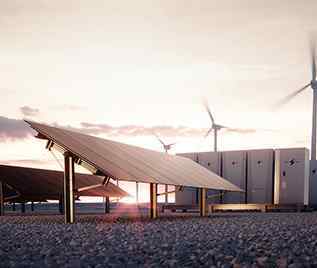
The global Grid-forming Inverter Market Size is projected to grow from USD 680 million in 2023 to USD 1,042 million by 2028, at a CAGR of 8.9% according to a new report by MarketsandMarkets™. Grid-forming inverters play a crucial role in efficiently integrating variable renewable energy sources, such as solar and wind, into the electricity grid. Grid-forming inverters actively regulate the grid's frequency and voltage to ensure that it remains within acceptable operating limits, even under varying renewable energy output or load conditions. Unlike traditional grid-tied inverters that synchronize with an existing stable grid, grid-forming inverters have the unique capability to independently create a stable grid environment when operating in islanded or standalone mode.
The factors that drive the Grid-forming inverter market growth is driven by the global transition towards clean and sustainable energy solutions, as well as the need for technologies that can enhance grid stability, reliability, and resilience in the face of evolving energy challenges.
Download PDF Brochure: https://www.marketsandmarkets.com/pdfdownloadNew.asp?id=9423236
Central Inverter is expected to result in the fastest growing segment in the Grid-forming Inverter Market.
The central inverter segment is expected to be the largest growing segment of the grid-forming inverter market size. The shift towards large-scale renewable energy projects, such as utility-scale solar farms and wind farms, demands high-capacity central grid-forming inverters to efficiently integrate the substantial power output from these installations into the electricity grid. As the world transitions to cleaner and more sustainable energy sources, central grid-forming inverters enable the integration of renewables into existing grids, supporting the energy transition away from fossil fuels.
Grid-forming Inverter Market Dynamics:
Drivers:
1. Rising investments in renewable energy sector
2. Growing demand for distributed solar energy resources supported by government-LED incentives
Restraints:
1. More expensive than traditional grid-following inverters
2. Grid-forming inverters are not compatible with all existing grid infrastructure
Opportunities:
1. Rising demand for electric vehicles
2. Growing investments in smart grid development
3. Growing adoption of high-power density inverters
Challenges:
1. Incompatibility of control algorithms used by grid-forming inverters with grid operating systems
2. Grid codes and regulations to pose challenge for grid-forming inverter deployment
Request Sample Pages: https://www.marketsandmarkets.com/requestsampleNew.asp?id=9423236
Asia Pacific is expected to be the largest region in the Grid-forming Inverter Market Size
Asia Pacific accounted for a 36.7% share with a grid-forming inverter market size worth USD 231.3 million in 2022. The Asia Pacific Grid-forming Inverter Market, by country, has been segmented into the China, India, Japan, Australia, South Korea, and and Rest of Asia Pacific. The deployment of energy storage systems, such as battery storage, is gaining momentum in the Asia Pacific region. Energy storage helps store excess renewable energy and discharge it when demand is high, contributing to grid stability and enhancing renewable energy integration. Governments are revising and introducing policies and regulations that facilitate renewable energy grid integration. These frameworks often address grid connection procedures, grid access for renewable energy projects, and market mechanisms for renewable energy trading.
Key Market Players:
Major players operating in the Grid-forming Inverter Market include Huawei Technologies Co. Ltd. (China), General Electric (US), SMA Solar Technology (Germany), Games Electric (Spain) and FIMER Group (Italy).
この記事をシェア